
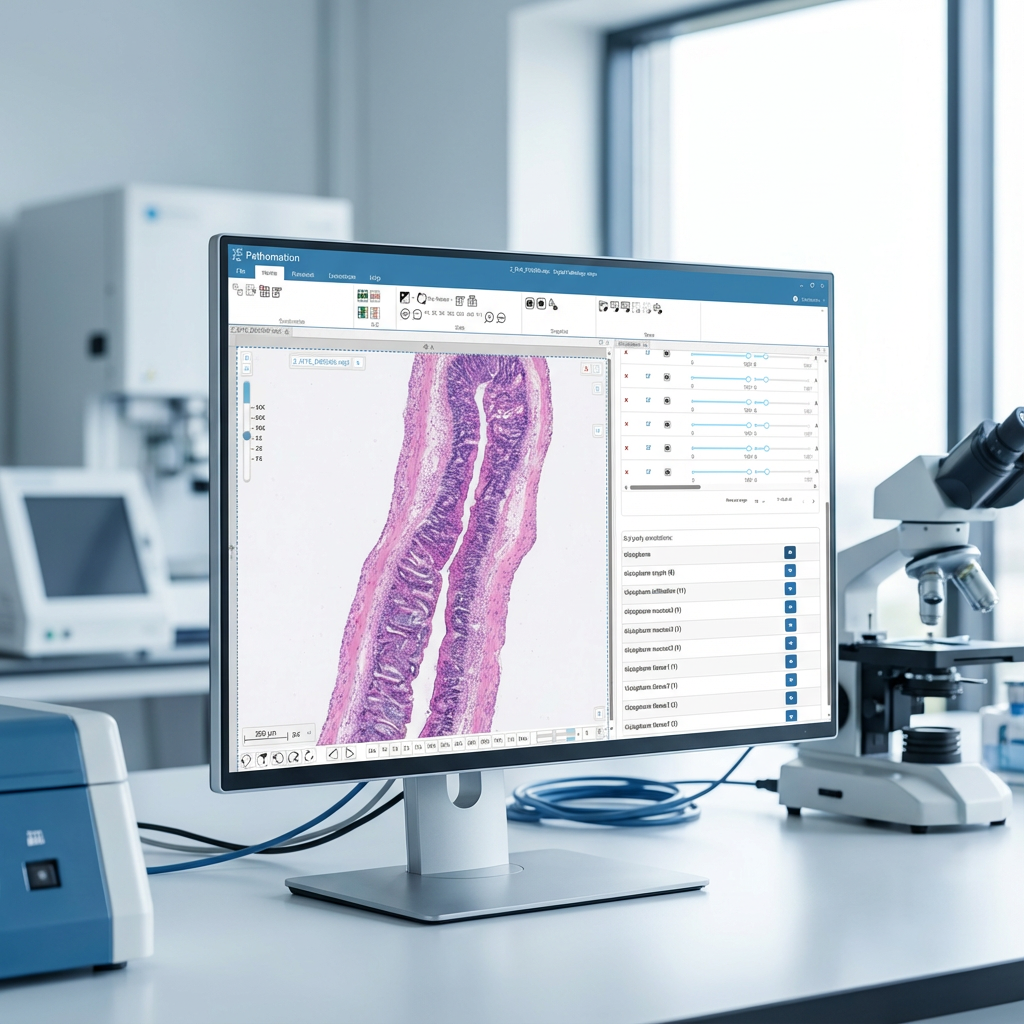
PIMS for Life Sciences
A unified environment for researchers working with Whole Slide Images
PIMS for Life Scienses centralizes your Whole Slide Images, metadata, annotations, and research tools into one unified, browser-based environment.
PIMS for Life Sciences eliminates window flipping, reduces manual workflows, and accelerates analysis.
By streamlining collaboration across teams and sites, PIMS LS increases research efficiency, shortens time to insight, and maximizes the return on your digital pathology investment.
Maximize your Return on Investment
Core capabilities of PIMS for Life Sciences
-
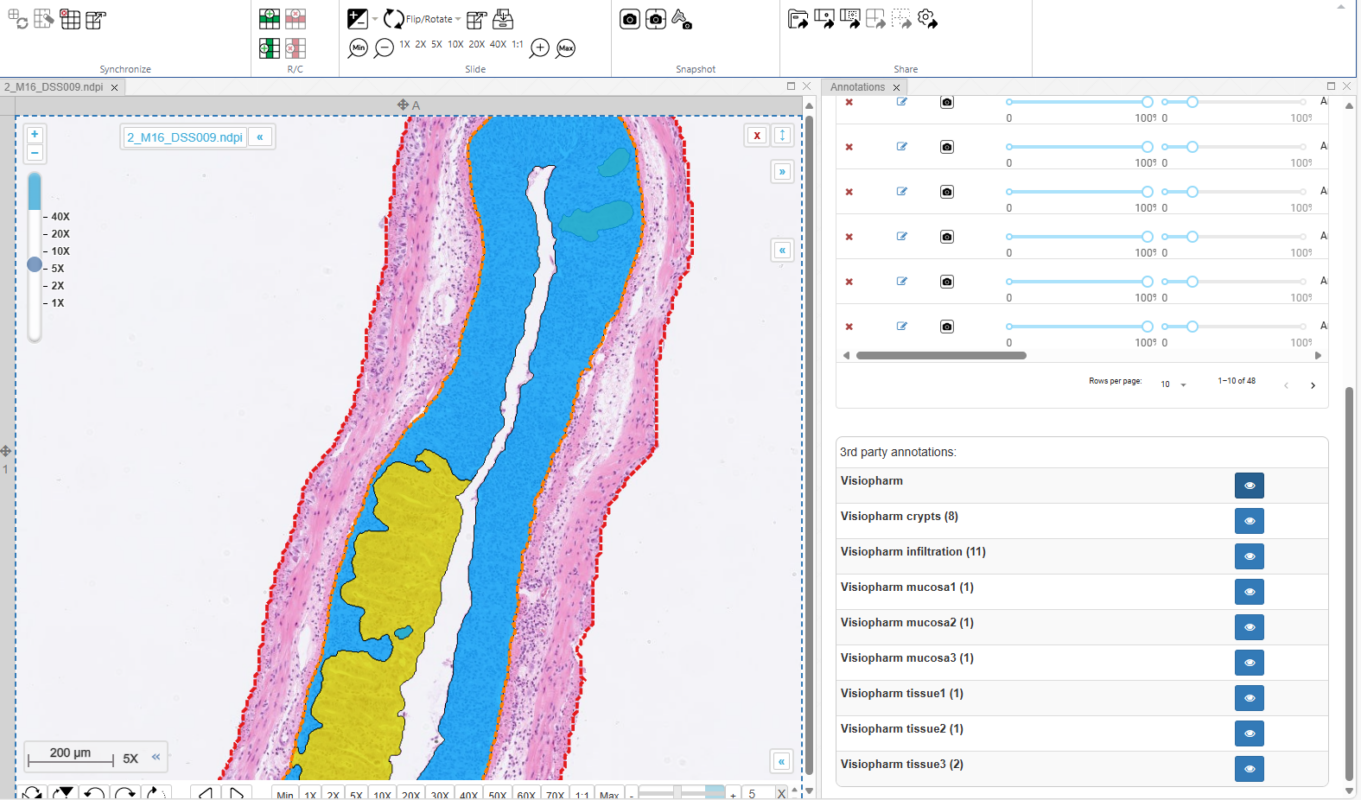
Create, edit, import, and manage complex annotations within one unified workspace. Integrate results from image analysis tools such as QuPath, ImageJ, Visiopharm, or HALO and review everything centrally.
PIMS LS acts as middleware, eliminating fragmented workflows and window flipping. -
Go beyond images. Capture structured data via customizable forms and integrate external metadata sources directly alongside your slides ensuring all relevant research information is accessible in one place.
-
Quickly retrieve slides across departments, storage locations, and projects using advanced search capabilities. Designed for large-scale research environments with complex image repositories.
-
Organize slides efficiently with flexible project structures and tray-based image sets. Reduce manual handling and accelerate study setup.
-
Export high-resolution figures with full control over macro images, labels, annotations, scale bars, and file formats ready for publications or reports.
-
Host live multi-head digital microscope sessions from anywhere. Invite collaborators via a simple link and review, annotate, and assess slides together in real time.
-
Seamlessly integrate third-party AI algorithms and image analysis software to enhance data processing and accelerate insight generation without disrupting your existing infrastructure.
PIMS LS supports:
Academic research institutions
Pharma & biotech research teams
AI developers working with Whole Slide Images
CROs and multi-site research networks
Designed for Scalable Research Environments
Whether you are building datasets, validating biomarkers, developing AI models, or running global studies: PIMS LS scales with your research.
Frequently Asked Questions
-
PIMSLS is a fully web-based digital pathology cockpit designed for research, image analysis, and AI-driven workflows.
It allows researchers, imaging scientists, and pathologists to work with whole slide images in a highly configurable environment, combining annotation, analysis, collaboration, and AI tools in one unified platform.
-
PIMSLS is designed for research pathologists, imaging scientists, bioinformaticians, AI developers, and research teams in academia, pharma, biotech, and CRO environments.
It supports workflows ranging from annotation and quantitative image analysis to AI development, validation, and collaborative research across distributed teams.
-
PIMSLS goes beyond traditional WSI viewers by offering a fully customizable and extensible research cockpit.
Users can configure panels, layouts, and workflows on the fly, integrate third-party analysis tools and AI algorithms, and connect to multiple storage systems. This makes PIMS LS suitable for complex and evolving research workflows rather than fixed viewing use cases.
-
Yes. PIMSLS includes built-in support for AI and advanced image analysis workflows.
Users can run AI algorithms on regions of interest or full slides, visualize results as overlays, and validate outputs within the same environment. This makes PIMS LS well suited for AI development, biomarker quantification, and pre-clinical research pipelines.
-
Yes. PIMSLS is designed for enterprise-scale research environments with large datasets, multiple users, and heterogeneous infrastructure.
It supports multiple storage backends, role-based access, extensive configuration options, and integration with other Pathomation components such as PMA.core, PMA.start, and My Pathomation.
-
You can reach us anytime via our contact page or email. We aim to respond quickly—usually within one business day.